
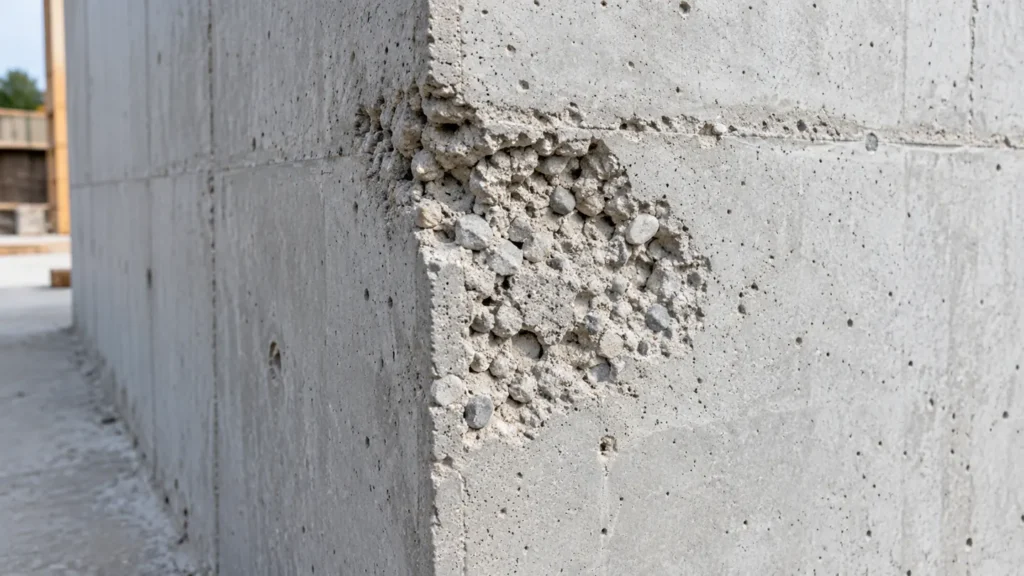
Concrete honeycombing is a defect in which voids and exposed aggregate interrupt the intended concrete matrix. It needs an assessment of its location, depth, extent, and effect before a repair method is selected. A surface patch can hide the appearance without establishing whether the concrete behind it is sound or whether reinforcement protection has been compromised.
Owners often first notice the problem when formwork is removed or finishes are stripped away. At that point, the useful question is not simply which mortar will fill the holes. The priority is to determine what the defect means for the particular member and how a proposed repair will restore the properties that matter.
Table of Contents
1. Distinguish concrete honeycombing from surface pores
Small surface pores and deeper areas of missing mortar do not necessarily represent the same defect. Photographs can reveal texture, but they rarely establish the depth or internal continuity of a suspect area. Avoid accepting a diagnosis based only on how rough the exposed face looks.
Record where aggregate is exposed, whether the surface appears connected to deeper voids, and whether reinforcement is visible. An assessor may need additional investigation to distinguish superficial imperfections from more extensive defective concrete. Do not use a guessed hole size as a universal threshold for repair or acceptance. The location, structural role, exposure conditions, and project requirements all influence the significance of what is found.
2. Establish the member’s role before intervention
Concrete honeycombing in a structural column, beam, wall, or slab warrants review by the responsible engineer. Even a modest visible area can occur at an important connection or extend beyond the exposed surface. The member’s role must inform both the investigation and the repair decision.
Collect available drawings, concrete records, and the circumstances in which the defect was discovered. Tell the engineer whether the element is already loaded and whether there are associated cracks, deformation, or other changes. Excavation or removal of concrete should not begin merely to discover how far the defect goes. The engineer should determine whether temporary measures, access restrictions, or a controlled investigation are needed before work proceeds.
3. Investigate why the defect developed
Possible contributing factors include placement difficulties, restricted access around reinforcement, leakage of mortar through formwork, and inadequate consolidation. The actual cause of concrete honeycombing should be investigated from project evidence rather than inferred from a single photograph. Several factors may have acted together.
Review where the defect occurs relative to construction joints, congested reinforcement, formwork interfaces, and concrete placement access. Compare neighboring areas where the work was completed under similar conditions. This investigation helps the team decide whether an isolated repair is sufficient or whether additional inspection is justified. It also identifies changes needed in future pours. Repairing the appearance while repeating the same placement conditions can allow the underlying production problem to continue elsewhere.
4. Map the concrete honeycombing extent
Prepare a defect map with photographs, dimensions of the visible area, member identification, and references to nearby edges or joints. Distinguish observations from conclusions: exposed aggregate is an observation, while a claim that the defect is shallow needs supporting evidence.
The engineer or qualified assessor should select any further investigation needed to evaluate depth and surrounding concrete. Testing methods have limitations and should answer a defined question, rather than being ordered as a generic assurance exercise. Record inaccessible faces and other uncertainties so they remain visible in the decision. Where the observed defect extends around a corner or into a connection, the repair boundary cannot be decided from one face alone. Investigation should establish the condition the repair must address.
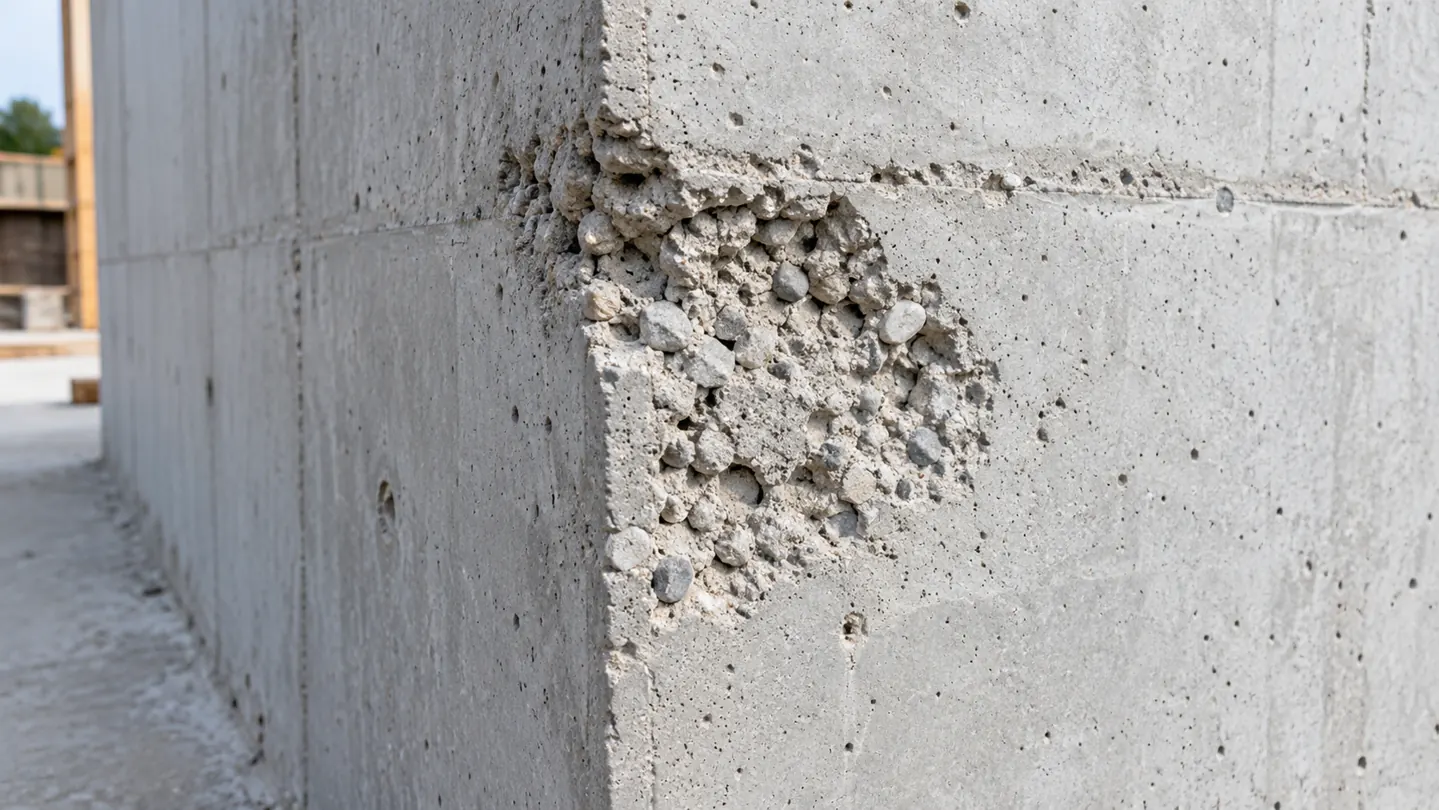
5. Review reinforcement and durability implications
Visible reinforcement is a reason to assess cover, bond conditions, and the environment around the steel. Filling the outer face does not automatically restore these properties. Concrete may need to provide both structural performance and protection from the surrounding exposure.
The assessment should identify whether steel corrosion is present, whether contamination is relevant, and whether defective concrete surrounds reinforcement beyond the visible opening. Decisions about reinforcement treatment or replacement belong in the engineered repair scope. Do not cut, bend, or expose additional steel without that direction. Ask the report to explain the required outcome, including how the proposed repair addresses the concrete-to-steel interface and the intended cover, rather than describing only the finished surface appearance.
6. Choose a compatible repair approach
Repair selection depends on the assessed defect, access, orientation, required properties, and application conditions. A vertical face, an overhead area, and a confined cavity may require different placement approaches. Product suitability should be demonstrated for the proposed use, not assumed from a general repair label.
Sika’s concrete repair overview illustrates the range of repair considerations and systems available. The project specification should connect the selected material to the required performance. Compatibility can involve dimensional behavior, bond, strength development, durability, and curing conditions. The highest advertised strength is not automatically the best match for existing concrete. Ask for the technical basis of the selection and any limitations affecting placement, thickness, or exposure.
7. Specify concrete honeycombing repair controls
An approved method should state the preparation requirements, repair boundaries, materials, installation sequence, and inspection points. It should also identify conditions that require work to stop and the engineer to review newly exposed information. Hidden defects discovered during preparation may change the original assessment.
This is a professional repair specification, not a recipe for removing load-bearing concrete. The responsible team must determine what can be removed safely and whether support is necessary. Sika’s new-build concrete repair information provides context for repair planning. Require the contractor to demonstrate that the chosen approach can reach the relevant surfaces and fill the assessed repair zone, including areas that will be difficult to see during placement.
8. Plan curing, verification, and acceptance
A repair remains vulnerable during its early development. Specify curing and protection according to the repair material and project conditions, including how weather, drying, vibration, or premature loading will be managed. Assign responsibility for maintaining those measures beyond the moment the mortar is placed.
Acceptance should evaluate the outcomes defined in the repair specification. Visual inspection may be useful, but it cannot answer every question about bond or internal condition. Carry out testing only where specified by the engineer or relevant repair requirements, with agreed criteria and timing. Our article on concrete curing methods and timing explains the broader importance of curing; a repair still needs instructions tailored to its own materials and site conditions.
9. Keep the repair decision traceable
The completed concrete honeycombing record should explain what was found, how it was assessed, what work was authorized, and how acceptance was established. Include photographs before concealment, material identification, relevant installation records, and changes approved during the work. These details are valuable when the element is inspected again.
For an owner comparing contractors, ask who provides engineering review and who signs off the completed repair. Explore Aloda Construction Company’s construction services and contact the team with clear photographs and available project records. A useful request describes the member, discovery stage, and any associated symptoms. It should seek an assessment-led scope, with the uncertainties resolved before cosmetic finishing makes the defect inaccessible.
Is concrete honeycombing always a structural problem?
No. Its significance depends on its depth, extent, location, and the member’s function. A qualified assessment distinguishes surface imperfections from defects that affect structural performance or durability; appearance alone cannot settle that question.
Can a contractor simply cover the affected area?
Covering may conceal evidence without addressing the defect. Establish the repair objective and obtain the appropriate assessment first, then use a specified method with inspection and acceptance requirements.
Does stronger repair mortar always give a better result?
No. Strength is one property among several. The material must suit the existing concrete, repair geometry, installation conditions, and required performance. An incompatible product can create difficulties even when its advertised strength is high.