
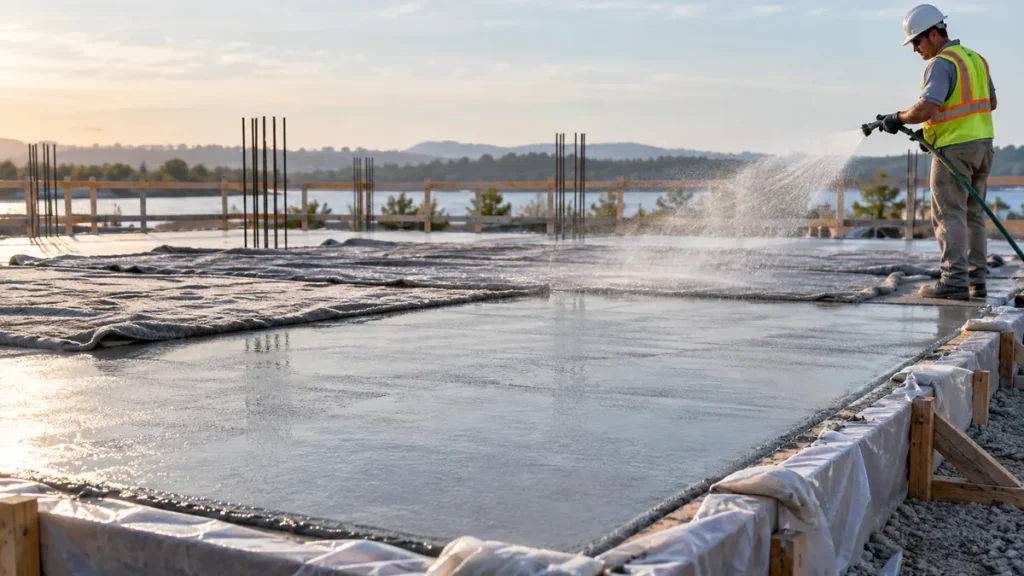
Concrete curing methods maintain suitable moisture and temperature conditions so cement hydration can continue and the concrete can develop its intended properties. Curing begins after placement and finishing at the time defined by the project method, and it must continue for the specified duration. It is not the same as allowing concrete to dry. Uncontrolled early moisture loss can reduce surface quality, increase permeability and contribute to cracking.
Table of Contents
The best method depends on the element, mixture, surface finish, weather, access and subsequent coatings or flooring. Slabs may be ponded, covered or treated with a curing compound; vertical formwork can help retain moisture; and precast production may use controlled heat and humidity. Whatever method is selected, the important outcome is continuous, verifiable protection during the critical early period.
Why do concrete curing methods matter?
Cementitious materials react with water through hydration. This reaction forms products that bind the concrete and refine its internal pore structure. If the concrete becomes too dry or too cold for the mixture, hydration slows and the near-surface zone may not reach its potential. Rapid evaporation can also create plastic shrinkage cracking before the concrete has developed enough tensile strength.
The American Concrete Institute curing resources define curing as maintaining moisture and temperature conditions to allow hydration and related reactions to develop potential properties. ACI also notes that curing supports strength and durability. Project specifications should set the governing methods, duration and acceptance requirements for the actual mixture and exposure.
Main concrete curing methods
Water curing
Water curing supplies moisture directly to the concrete surface. Methods include ponding, immersion, fogging, spraying and continuously wet coverings. It can be highly effective when water is clean, the temperature is suitable and the surface stays continuously wet. Intermittent wetting that allows repeated drying is undesirable because it creates unstable moisture and temperature conditions.
Ponding suits flat, contained surfaces but adds load and requires watertight edges. Sprinklers or fogging need reliable coverage and drainage. Wet burlap, fabric or mats should be prewetted and kept in close contact without staining the concrete. Wind can lift coverings or dry exposed corners, so laps and weights require inspection.
Moisture-retaining sheet materials
Plastic sheets or specialized curing blankets limit evaporation. They are relatively simple and reduce water demand, but they must cover the entire surface with sealed or weighted overlaps. Wrinkles, trapped water and uneven contact can cause appearance variations on architectural concrete. Sheets should be light-coloured or otherwise suitable for the expected solar exposure and surface-temperature control.
Membrane-forming curing compounds
Curing compounds are sprayed or rolled onto the surface to create a film that reduces moisture loss. They are practical for large slabs, pavements and locations where continuous water curing is difficult. Correct product approval, application rate, uniform coverage and timing are essential. A white-pigmented product can help an inspector see coverage and may reduce solar heating in exposed work.
Compatibility must be checked before use. Some films can interfere with later floor adhesives, coatings, toppings or sealers and may need approved removal. Sprayers should be clean, calibrated and able to maintain an even application. Areas damaged by traffic or following trades require repair.
Curing in formwork
Leaving formwork in place reduces evaporation from formed surfaces, especially walls, columns and beam sides. Joints and exposed tops still need protection, and timber forms may require wetting according to the method statement. When forms are removed before the specified curing period ends, another curing method should begin immediately on the exposed concrete.
Steam or heat-assisted curing
Controlled heat and moisture can accelerate early strength development in precast or specialized operations. The temperature cycle must be engineered to avoid excessive gradients, delayed durability problems or thermal cracking. Heat without moisture is not equivalent to curing. Monitoring should include the concrete or enclosure temperature rather than only the heater setting.
Internal curing
Internal curing uses water stored within absorptive materials, often prewetted lightweight aggregate, to support hydration from inside the concrete. It can be valuable for low water-to-cementitious-material mixtures, but it is a designed mixture strategy rather than an improvised replacement for external protection. The ACI technical note on internal curing efficiency provides a specialist reference.
How to choose concrete curing methods
| Project condition | Potential method | Important check |
|---|---|---|
| Large horizontal slab | Wet covering, sheet or curing compound | Full coverage and compatibility with flooring |
| Architectural surface | Approved controlled method | Staining, wrinkles, colour variation and mock-up |
| Wall or column | Forms retained, then wet wrap or compound | Exposed tops, form joints and prompt transition |
| Hot, dry or windy exposure | Evaporation control plus immediate curing | Surface moisture, wind protection and temperature |
| Precast element | Controlled enclosure or accelerated curing | Approved temperature and moisture cycle |
| Future bonded finish | Compatible water or sheet method | Adhesion requirements and residue removal |
The decision should be made before the pour. Confirm water availability, drainage, covering quantity, sprayer capacity, labour and backup equipment. Coordinate with formwork removal, saw cutting, loading, finishing and later coatings. Waiting until the slab is complete to search for curing materials invites gaps during the most sensitive period.
When should concrete curing start?
Curing should start as soon as the surface condition and finishing operation allow without damaging the concrete. The exact sequence varies by element and specification. Before final curing can begin, fogging, windbreaks, sunshades or an approved evaporation reducer may be required to protect the surface. These measures support placement but do not necessarily replace the specified curing system.
For horizontal work, finishing crews and curing crews should coordinate a moving front so completed areas are protected promptly. Vertical elements need attention at the exposed top surface and again when forms are stripped. Transitions between methods should occur without a dry interval.
How long should concrete be cured?
There is no single duration suitable for every mixture and condition. The project specification may define time, achieved strength, maturity or another performance basis. Cement type, supplementary cementitious materials, temperature, member geometry, exposure and desired durability influence the requirement. Some mixtures gain strength more slowly and benefit from extended moist curing.
Do not stop curing only because the surface feels hard or because a standard-age strength test will be performed later. Field-cured samples, maturity data or other project-approved evidence may inform stripping and loading decisions, but they should be used within a documented plan. The engineer responsible for the specification should approve deviations.
Curing concrete in hot, cold and windy weather
Hot or windy conditions
High concrete temperature, low relative humidity, wind and solar radiation can accelerate evaporation. Plan cooler materials or placement periods where appropriate, provide shade and wind protection, minimize delays and have curing supplies ready. Monitor actual site conditions rather than relying only on a general forecast. Edges and thin sections are especially vulnerable.
Cold conditions
Cold weather slows hydration and can expose young concrete to freezing damage. Protect the element with insulation or controlled enclosures according to the approved plan. Avoid abrupt temperature changes when protection is removed, especially in thicker members. Combustion heaters require careful control because they can create safety, moisture and surface-quality issues.
Curing and temperature protection are connected but not identical. A heated surface can still lose moisture, and a wet covering may be unsuitable if it freezes. The method needs to control both conditions for the specified period.
Concrete curing methods inspection checklist
- Confirm the approved mixture, specification and curing method before placement.
- Check weather, evaporation risk and planned protective measures.
- Verify that water, sheets, coverings, compound and backup equipment are on site.
- Record placement time, finishing completion and curing start time by area.
- Inspect continuous moisture, sealed laps or uniform compound coverage.
- Check slab edges, corners, penetrations, column tops and repaired areas.
- Record temperatures where required by the method or specification.
- Protect curing systems from traffic, lifting, debris and following trades.
- Document any interruption and the approved corrective action.
- Confirm specified duration before removing protection or applying finishes.
Inspection records should identify exact pour locations and use photographs that show the full area as well as detailed defects. Coordinate these records with the project’s construction inspection process once both campaign articles are live.
Common curing mistakes
Typical mistakes include starting late, stopping early, allowing coverings to dry, leaving edges exposed and applying too little curing compound. Other problems arise when workers walk on sheets, wind opens laps, water causes erosion on a fresh surface or a compound conflicts with a later bonded finish. Leaving forms in place while ignoring the top surface is another recurring gap.
Adding water to the surface during finishing should not be confused with curing and can damage the surface if used improperly. Similarly, strength tests do not compensate for poor field protection. Test specimens kept under different conditions may not represent the actual surface zone of a slab.
Frequently asked questions about concrete curing methods
Is water curing always the best method?
Water curing can be very effective, but site conditions, element geometry, appearance, water availability and later finishes may make sheets, compounds or combined methods more practical. The specification governs the selection.
Can concrete cure under plastic?
Yes. Properly installed sheet material can retain moisture effectively. It must cover the whole surface, remain sealed and be suitable where colour variation or surface appearance matters.
Does rain count as concrete curing?
No. Rain is uncontrolled and may damage fresh concrete before it has hardened. After the surface is suitable, moisture can support curing, but the project still needs a continuous approved method and protection plan.
Can curing compound remain under floor finishes?
Only if the products and project requirements confirm compatibility. Some compounds can reduce adhesion and must be removed or replaced with another curing approach.
What happens if curing is interrupted?
Restore the approved conditions as quickly as possible, document the location and duration, and obtain technical review when required. The effect depends on concrete age, mixture, weather and exposure.
Conclusion
Successful concrete curing methods control moisture and temperature continuously from the earliest practical time through the specified duration. Choosing the method before placement, verifying coverage and protecting it from disruption are as important as the product itself. For coordinated concrete execution, inspection and quality management, review Aloda Construction Company services or contact the team.