The desire to expand a home is a natural stage in the evolution of the Kuwaiti family and its growing numbers. Many resort to adding annexes, building additional floors, or expanding halls to accommodate new needs. However, a large segment of owners overlooks a crucial engineering step that, if ignored, could lead to structural and financial disasters later: soil testing before expanding an existing house. Aloda Construction Company, with over 18 years of experience in the heart of the Kuwaiti market, has observed numerous cases of cracking and subsidence in annexes and expansions executed randomly without a prior geotechnical study.
Important Advice on Soil Testing Before Expanding an Existing House
There is a common misconception that because an old building has remained stable for many years, the surrounding soil is necessarily strong and capable of bearing new loads; this is engineeringly incorrect. Reality confirms that adding new loads to untested soil, adjacent to old foundations that have already settled, is a complex equation requiring extreme caution. In this comprehensive article, we will dive into the technical and engineering details of the importance of soil testing, and how this simple procedure can protect your home from cracks, subsidence, and structural failures, providing you with a safe guide to expanding your “dream home” with confidence.
Why is Soil Testing a Necessity and Not a Luxury?
The nature of soil in Kuwait varies from one area to another and can even vary within a single plot. When considering soil testing before expanding an existing house, we are not just looking for the bearing capacity of the ground, but also for the changes that have occurred over the years you have lived in the house. Invisible water leaks from sewage or water supply networks may have occurred, leading to soil “washout” or moisture saturation, which weakens its load-bearing capacity.
Furthermore, the new loads added by the expansion differ in their distribution and center of gravity from the original building. The structural engineer needs accurate figures (SBC – Soil Bearing Capacity) to design the expansion foundations correctly. Relying on guesswork or old soil reports that are decades out of date is a dangerous gamble that may lead to the new building tilting or separating from the old one.
The Risks of Differential Settlement
The phenomenon of differential settlement is the ultimate nightmare for any construction engineer. This occurs when the new part of the building (the expansion) subsides at a different rate than the old part. The old building has reached its final position, and its soil has settled and compacted (consolidation) over the years, while the new expansion will be built on “virgin” soil or soil with different characteristics.
The absence of soil testing before expanding an existing house leads to the design of unequal foundations, resulting in:
- Vertical and Diagonal Cracks: Appearing clearly at the junction points between the new and old building.
- Floor Fractures: Breaking of ceramics and marble due to the movement of the concrete slab beneath them.
- Difficulty Opening Doors and Windows: Due to the deformation of wooden or aluminum frames caused by tilting walls.
- Damage to Utilities: Bursting of buried water and sewage pipes due to soil movement, which exacerbates the problem.
Kuwaiti Soil Nature and Groundwater Challenges
Soil in Kuwait is characterized by its diversity between sandy, limestone (Gatch), and clay layers in some coastal areas. Additionally, the rise in the groundwater level represents a major challenge in many residential areas. Performing soil testing before expanding an existing house reveals the current water level, which may have changed since the original home was built due to surrounding urban development or environmental changes.
If excavation and pouring of new foundations occur without considering nearby groundwater, it will lead to the corrosion of reinforcement steel and the disintegration of concrete in the future, in addition to moisture problems that will creep into the expansion walls and destroy paint and decorations. A modern soil report determines the type of salt-and-sulfate-resistant cement that must be used and the appropriate type of insulation to protect the foundations.
Technical Soil Testing Steps
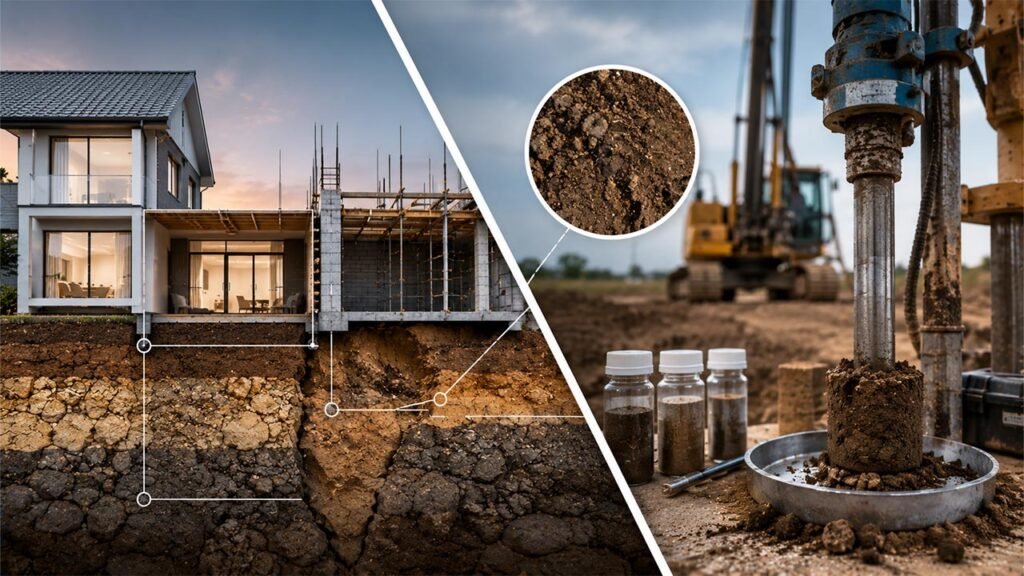
The soil testing process is carried out in a scientific, studied manner that does not cause significant inconvenience to the residents. The process begins with a visit from Aloda Construction Company engineers to determine the locations for the proposed “boreholes.”
The practical steps are summarized as follows:
- Taking Boreholes: Deep holes are drilled into the ground (usually at a depth ranging from 10 to 20 meters depending on the building type) at the site of the proposed expansion, using special drilling equipment that can enter tight spaces in courtyards.
- Sample Extraction: Samples are taken from different soil layers and sealed to maintain their natural moisture.
- Laboratory Analysis: Samples are taken to the lab to measure their moisture content, sulfates, and salts, and to determine their density and bearing strength.
- Issuing the Report: The lab provides a detailed report recommending the type of foundations (isolated footings, raft, or piles) and the safe founding depth.
Engineering Solutions for Connecting the Old and the New
Based on the results of soil testing before expanding an existing house, our engineering team develops structural solutions to ensure the two buildings bond safely. One of the most important solutions is the use of “Expansion and Settlement Joints.”
The structure of the new expansion is structurally separated from the old structure by a studied joint, which is later covered with flexible finishing materials and special treatments that prevent water and insect leakage and visually hide the joint. This joint allows the new building to undergo natural, minor subsidence without “pulling” the old building with it and causing cracks. In some cases where the soil is very weak, we may resort to “injection” techniques to strengthen the soil or use “micropiles” to support foundations in narrow spaces.
| Step | What happens |
|---|---|
| 1. Taking boreholes | Deep holes are drilled at the site of the proposed expansion — usually 10 to 20 metres depending on the building type — using equipment that fits into tight courtyards |
| 2. Sample extraction | Samples are taken from the different soil layers and sealed, so their natural moisture is preserved on the way to the lab |
| 3. Laboratory analysis | Moisture content, sulfates and salts are measured, and density and bearing strength are determined |
| 4. Issuing the report | A detailed report recommends the foundation type for the expansion |
Economic Feasibility of Testing
Some may view the cost of soil testing and testing laboratories as an extra cost that can be saved. However, the economic reality we always emphasize at Aloda Construction Company is that the cost of soil testing before expanding an existing house is very low compared to the cost of “crack repair” and subsidence treatment that you might be forced to pay later.
The cost of repairing sunken foundations and soil injection after a problem occurs can reach multiples of the construction cost itself, not to mention the inconvenience, psychological distress, and disfigurement of the home. Prior testing is like an “insurance policy” that protects your real estate investment and ensures your peace of mind.
Safety Considerations While Working Near Old Foundations
The soil report also reveals the cohesion of the upper layers, which helps us determine the safe excavation method. Deep excavation next to the foundations of an existing home without study may lead to “soil escape” from under the old foundations, causing tilting or partial collapse of existing walls.
Based on the report’s recommendations, we take the necessary shoring measures for the excavation sides, protect the old foundations, and ensure they are not affected by vibrations from the equipment. Safety in expansion and renovation projects requires much higher precision and sensitivity than construction projects on vacant land.
The Role of Aloda Construction Company
Aloda Construction Company is distinguished by the fact that it does not start any expansion or major renovation project without ensuring the safety of the ground it will build on. We consider the client a partner, and our professional duty requires us to educate them about invisible risks.
- Integrated Coordination: We cooperate with the best accredited soil laboratories in Kuwait to ensure the accuracy of results.
- Precise Structural Design: Our structural engineers translate the report numbers into steel and concrete blueprints that ensure total safety.
- Professional Execution: We use high-quality building materials and pouring and treatment techniques that prevent connection problems between old and new concrete.
In conclusion, the decision to expand your home is a wonderful one that adds space and comfort to your family; do not let it turn into a source of anxiety. The correct procedure starts from underground. Committing to soil testing before expanding an existing house is the first step toward a solid and durable construction. Do not gamble with your home’s foundations, and do not rely on expectations. Contact Aloda Construction Company today, and let us put 18 years of experience in your hands, to build an expansion that increases the value and beauty of your home and stands firmly and strongly against the test of time.
Quick Answers
The old house has stood for years — why test the soil at all?
Because a building standing for years does not prove the ground can carry new loads; that reasoning is engineeringly incorrect. Soil in Kuwait varies between areas and even within a single plot, and the groundwater level may have shifted since the original house was built, driven by surrounding urban development.
What is differential settlement?
It is the new part of the building subsiding at a different rate from the old part. The soil under the existing house has already consolidated under decades of load; freshly loaded soil beside it has not — and the two move apart at the joint.
What does the test involve on site?
Boreholes 10 to 20 metres deep depending on the building type, drilled with equipment small enough for a courtyard; sealed samples from each soil layer; lab analysis of moisture, sulfates, salts, density and bearing strength; and a report recommending the foundation type.