The kitchen is the beating heart of any home and the hub from which the scents of memories and delicious dishes emerge, especially in Kuwaiti and Gulf societies known for their generous hospitality and continuous banquets. However, this heart often turns into a source of annoyance due to rising temperatures and the spread of pungent cooking odors throughout the rest of the house, affecting the comfort of residents and indoor air quality.
Aloda Construction Company, drawing on its prestigious experience of over 18 years in building and finishing homes in Kuwait, recognizes that kitchen planning to reduce heat and odors is not just a luxury, but an engineering and health necessity that must be considered from the very first moments of architectural drafting.
You may also be interested in: [Designing a luxury guest bathroom in the home].
Essential Tips for Kitchen Planning to Reduce Heat and Odors
Many homeowners face a real challenge in balancing a modern open-kitchen design with the control of heat and odors, especially under Kuwait’s extremely hot climate. The solution lies not only in purchasing expensive extraction fans but in smart engineering distribution and studied airflow paths. In this article, we provide the essence of our expertise to guide you on how to design an ideal cooking space that ensures a healthy, cool, and odor-free environment.
1. The Strategy of Separation: The Hot and Cold Kitchen
The dual kitchen system (preparatory kitchen and main/hot kitchen) is one of the most successful architectural solutions used in modern Kuwaiti villas to implement the concept of kitchen planning to reduce heat and odors with maximum effectiveness. This principle relies on isolating heavy-duty operations that produce intense heat and smoke—such as frying and cooking with large pots—into a dedicated, insulated space called the “Hot Kitchen” or (Dirty Kitchen), while the open internal kitchen (Pantry) remains for light tasks and coffee preparation.
This separation helps confine heat and odors to a narrow space that is easy to control and mechanically ventilate, without affecting reception halls or living rooms’ air conditioning or air purity. At Aloda Construction Company, we pay great attention to insulating the hot kitchen using airtight doors and specialized wall and floor fittings that withstand high temperatures and are easy to clean from accumulated oils.
2. Stove Location and the Enhanced Work Triangle
The location of the stove (oven) plays the largest role in heat dissipation. When striving for kitchen planning to reduce heat, placing the stove directly under a window must be avoided—a common mistake. Air currents coming from the window can hinder the hood’s performance and may even push odors and vapors back into the kitchen instead of out, in addition to the risk of extinguishing the flame or affecting cooking efficiency.
Furthermore, the stove should be placed at the nearest possible point to the exterior wall to minimize the length of ventilation ducts. The shorter the duct path and the fewer its bends, the higher the efficiency of drawing odors and heat outside. It is always preferable for the stove to be away from direct AC vents and kitchen entrances to prevent odors from traveling with person movement and cross-drafts.
3. Ventilation Techniques: Hoods and Air Paths
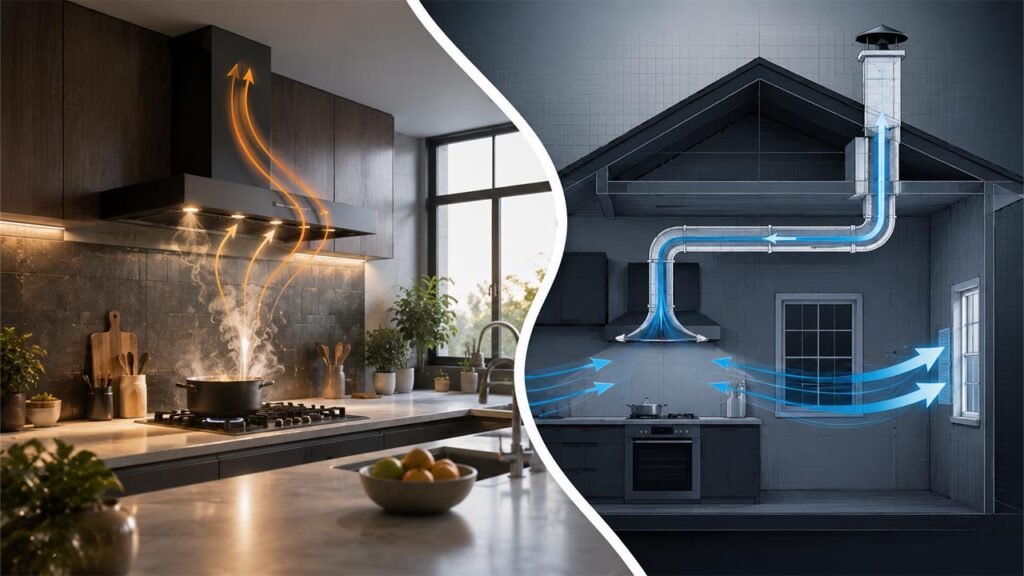
A healthy kitchen system is incomplete without a powerful mechanical ventilation system. The success of kitchen planning to reduce heat and odors depends fundamentally on choosing a hood with the appropriate capacity (CFM) and size. The hood width should be equal to or slightly larger than the stove width to ensure all rising vapors are captured before they spread to the ceiling.
In our hot Kuwaiti environment, Aloda Construction Company strongly recommends using an external discharge (Ducted) system. This is the only system capable of expelling actual heat outside the house, whereas recirculating (Filter) systems merely recycle hot air after purifying it from fats, keeping the kitchen hot. “Negative pressure” must also be considered within the kitchen, ensuring the amount of air drawn out is slightly greater than the air coming in to prevent odors from leaking to adjacent rooms through gaps under doors.
4. The Relationship Between AC and Kitchen Ventilation
Many designers make a fatal error when distributing AC vents in the kitchen, causing any attempt at kitchen planning to reduce heat to fail. If the AC air outlet (Grill) is directed toward the stove or the hood, the cold air current will scatter the rising vapors and prevent the hood from capturing them, leading to odors spreading and grease condensing on the AC units themselves.
Based on this, our engineers at Aloda Construction Company carefully study HVAC blueprints to ensure air outlets are away from the direct cooking area, cooling the “dead zones” in the kitchen instead. This creates an air balance that allows the hood to operate at peak efficiency, drawing out hot air and odors smoothly.
5. Finishing Materials and Odor Absorption
It is often overlooked that the quality of materials used for walls and surfaces contributes to the persistence of unpleasant odors. Porous surfaces like certain types of untreated natural stone, low-quality wood, or standard paints act like a sponge in absorbing frying and spice odors, re-emitting them as temperatures rise.
To achieve kitchen planning to reduce heat and odors, we recommend using non-porous surfaces such as quartz or treated granite for countertops and high-quality ceramic or porcelain for walls, especially the backsplash. For cabinets, materials treated with protective layers (such as acrylic or aluminum) are preferred as they do not absorb oils and are easy to wipe down.
6. Lighting and Its Thermal Impact
Traditional lighting (such as halogen) contributes significantly to raising the kitchen temperature, especially in small spaces with low ceilings. When designing lighting, we shift entirely toward modern LED technologies. These lights emit negligible heat, reducing the thermal load inside the kitchen and easing the strain on AC units.
Moreover, correctly distributing lighting over workspaces facilitates cleaning; grease spots can be seen and removed immediately before they burn and emit foul smells. Hidden lighting under upper cabinets is a practical and aesthetic solution that serves this purpose perfectly.
7. Windows and Cross Ventilation
Despite the heavy reliance on AC in Kuwait, a window in the kitchen is vital for natural light and air renewal during moderate weather. Kitchen planning to reduce heat and odors relies on the principle of cross ventilation whenever possible—having two opposing windows or a window and a door to create a natural draft that sweeps heat and odors out quickly. High-quality, heat-insulated (Double Glazing) windows should be chosen to prevent intense solar heat from entering during the day.
Why is Aloda Construction Company Your Best Choice?
Executing a kitchen with these precise specifications cannot be left to chance or amateurs. It requires high coordination between civil, electrical, mechanical, and carpentry works. We at Aloda Construction Company provide integrated (turnkey) solutions that ensure kitchen planning to reduce heat and odors is implemented to the letter.
- Path Studies: We map out movement and air paths before laying a single brick.
- Material Selection: We help you select the best heat and moisture-resistant materials from local and international markets.
- Precise Execution: Installing ventilation ducts and insulating them to prevent noise and vibration.
- Maintenance: We provide designs and advice that facilitate the maintenance of hoods and AC units to ensure continued efficiency.
In conclusion, the kitchen is the kingdom of the house and should not be a place of suffering from heat and smells. Investing in proper planning is an investment in your family’s health and psychological comfort. Contact Aloda Construction Company today, and let us help you build the dream kitchen that combines design beauty, performance efficiency, and air purity.